
Honor Their Service. Carry Liberty Forward.
📌 Key Takeaway: Elections choose who holds office. Citizens decide, every day after, whether those offices answer to the people.
Honor Their Service
This article arrives on Veterans Day. The day began as Armistice Day. Fighting in World War I stopped on the eleventh hour of the eleventh day of the eleventh month of 1918, and in 1954 Congress renamed the holiday Veterans Day to honor American veterans of all wars.
Today we honor all who have served, and we remember those who gave their lives for our freedom. Our gratitude should be more than words. The men and women who served swore an oath to support and defend the Constitution. We honor that service by serving our neighbors, staying informed and standing peacefully for the liberties entrusted to us. If you have a veteran in your life, thank them by name this week.
God has this. But faith does not call us to the sidelines. He has given us an opportunity to serve, seek truth and bring light into difficult places. We can begin right where we are.
The Morning After Is Where Citizenship Starts
Washington voted on November 3. Some of you were encouraged by the results. Some of you were frustrated. Many of you were simply tired. All of those reactions are human, and none of them change the basic fact our Founders built into this country: in a constitutional republic, the people do not clock out when the polls close.
Under state law, each county canvassing board must finish its canvass and certify general election results 21 days after the election. For this year, that means by November 24. Until then, election officials are still counting, reviewing and reconciling ballots. After that, the work moves from the ballot box to the places where laws are written, budgets are set and public officials are held accountable.
That is where a lot of citizens drift away. It is also where your voice can carry the furthest.
💡 Pro Tip: Write down three issues you care about most this year. Pick one you will actually follow from now through the end of the 2027 legislative session.
You Have More Access Than You Think
Here is something many Washingtonians do not know: you do not have to drive to Olympia or hire a lobbyist to be heard by the Legislature.
Washington's regular legislative session begins on the second Monday of January. In 2027, that is January 11. During session, any member of the public can sign in to a committee hearing on a bill and choose to:
- Note a position for the legislative record (support, oppose or other) without speaking.
- Submit written testimony, which can be filed online up to 24 hours after the hearing starts.
- Testify in person or remotely. Remote testifiers receive a Zoom link by email. Sign-in closes one hour before the meeting.
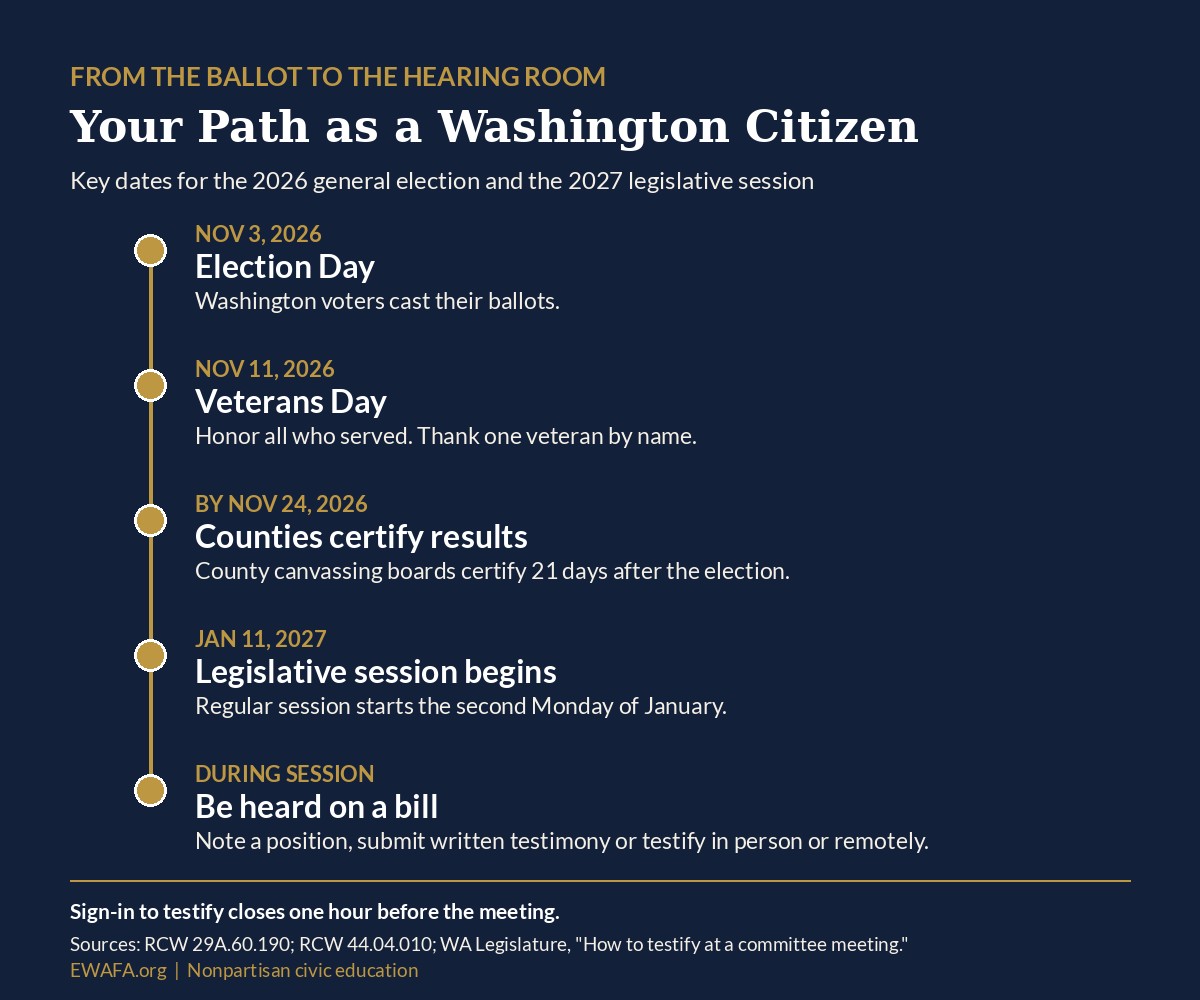
All of it starts at the Legislature's committee sign-in page. It takes a few minutes. It goes on the record. And it reminds lawmakers that people back home are paying attention.
⚠️ Heads Up: Committee hearings move fast. Sign-in to testify closes one hour before the meeting. Subscribe to committee updates early so a bill you care about does not pass through a hearing before you know it was scheduled.
Know the Document Before You Debate It
Every argument about rights eventually comes back to one document. The Constitution and its 27 amendments fit in a short read. You can read the full transcript from the National Archives in under an hour.
Read it before you argue about it. Read the First Amendment before you argue about speech and religion. Read Article I before you argue about what Congress may do. Read the Tenth Amendment before you argue about what belongs to the states and to the people. A citizen who has read the text is harder to mislead, and much more persuasive.
📌 Key Takeaway: Constitutional knowledge is not a partisan weapon. It is the shared rulebook that lets free people disagree without breaking the country.
Disagree Without Dividing
EWAFA is not a party, and this is not about left or right. It is about truth, liberty and the habits that make self-government work.
One of those habits is honest disagreement. A republic depends on neighbors who can argue hard and still share a table. That means:
- Lead with sources. Share where your facts came from, and ask the same of others.
- State the other side fairly. If you cannot describe a view well enough that its holders would agree, you are not ready to rebut it.
- Separate people from positions. You can oppose a policy without treating your neighbor as an enemy.
- Stay curious. Ask what someone read, what they saw and what worries them.
None of that means giving up conviction. It means earning the right to be heard.
What We Are Building for 2027
EWAFA is developing two forums for 2027. Both are proposed, dates and locations are still to be determined, and they will come together as support and partners come together.
Pastors Forum: For Such a Time as This. A proposed gathering to encourage and equip pastors and church leaders across denominations with clear teaching on biblical citizenship, the Constitution and what churches can lawfully do. Many pastors want to serve their communities well and are unsure where the lines are. This forum is meant to help them lead with clarity and grace.
Youth Forum. A proposed space where young people with differing viewpoints, conservative and liberal, weigh the evidence, debate respectfully and every side is heard. The goal is not to tell young Washingtonians what to think. It is to help them think well, test claims against facts and practice the kind of civil disagreement a free country needs.
If you know a venue, a speaker who teaches with clarity and fairness, or a pastor, teacher or student who should be part of shaping these forums, reply to the newsletter or reach us at [email protected].
Three Actions Before the New Year
- Read one founding document. Start with the Constitution transcript at the National Archives. Share one thing you learned with someone in your home.
- Get ready for session. Bookmark the Legislature's committee sign-in page and the "How to testify" guide. Pick one issue to follow starting January 11.
- Bring one neighbor. Forward this brief to one person who sees things differently than you do, and talk about it.
💡 Pro Tip: Do not try to move a crowd. Start with one person you know by name.
Stand Up. Stand Tall. Stand Together.
Benjamin Franklin, leaving the Constitutional Convention in 1787, was reportedly asked what kind of government the delegates had created. His answer, as recorded by Maryland delegate James McHenry: "A republic, if you can keep it."
Keeping it was never a one-day job, and it was never only the work of those who wore the uniform. It is the work of ordinary citizens who learn the rules, speak up, listen well and show up again the next day.
Stay connected: follow EWAFA on X at https://x.com/EWAFAorg and join the EWAFA Facebook group at https://www.facebook.com/groups/ewafa.
Empowering WA Freedom Alliance is a nonpartisan 501(c)(3). EWAFA does not endorse or oppose any candidate or party.
Sources
-
Cover image and timeline graphic: EWAFA-created (cover is AI-generated illustrative art; timeline dates from the sources below).
-
Washington county certification timing: RCW 29A.60.190 (county canvassing board certifies 21 days after a general election). https://app.leg.wa.gov/rcw/default.aspx?cite=29A.60.190
- Legislative session start date: RCW 44.04.010 (regular sessions commence on the second Monday of January). https://app.leg.wa.gov/rcw/default.aspx?cite=44.04.010
- How to testify, note a position or submit written testimony (sign-in closes 1 hour before; written testimony up to 24 hours after start; Zoom link emailed): Washington State Legislature, "How to testify at a committee meeting." https://leg.wa.gov/bills-meetings-and-session/session/how-to-testify-at-a-committee-meeting ; Committee sign-in: https://app.leg.wa.gov/csi
- Veterans Day history (armistice at the eleventh hour of the eleventh day of the eleventh month, 1918; Public Law 380 renamed the holiday on June 1, 1954): U.S. Department of Veterans Affairs, "History of Veterans Day." https://www.va.gov/opa/vetsday/vetdayhistory.asp
- U.S. Constitution full transcript: National Archives. https://www.archives.gov/founding-docs/constitution-transcript
- Franklin, "A republic, if you can keep it": recorded in the notes of James McHenry, Sept. 18, 1787 (published in The American Historical Review, Vol. 11, 1906). Widely cited; attribution is to McHenry's account.
- Pastors Forum and Youth Forum descriptions: EWAFA internal planning drafts (plans/pastor-forum/one-page-summary.md; growth plan). Proposed, dates TBD.
